The children that changed the World forever
In the year 2065, the world is different—so bright and peaceful that I sometimes still wonder if I am dreaming.
But I remember. I remember what life was like in my childhood, back in the dark year of 2025.
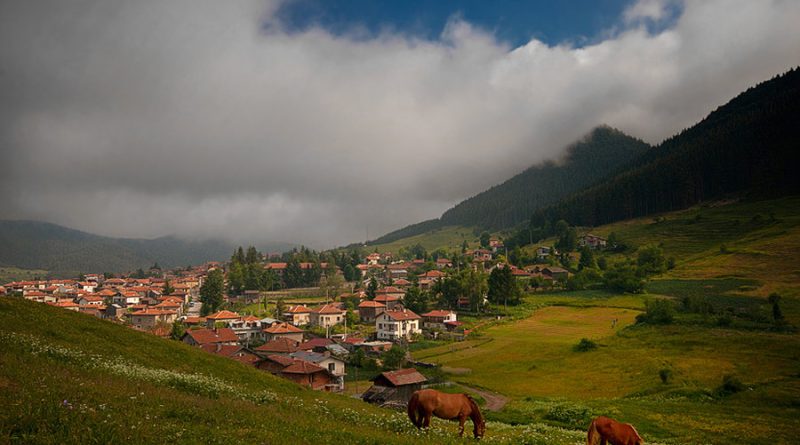
I was ten, living with my parents in a small village in the Rhodope Mountains. In the evenings, we listened to the troubling news of war—the dreadful war in Ukraine that consumed human lives and cast its shadow over our future, and the bombings in Gaza, where thousands of innocent children perished.
By my side often sat a Ukrainian girl, a refugee sheltered in our village. She watched the news and silently wept for her father, who had stayed behind to fight. In those moments I realized how deeply suffering carves itself into the souls of innocent children.
It was then that I decided I would do everything in my power to make sure there would never again be war. And if the adults could not stop the bloodshed, then we, the children, had to do something.
I remembered the words of a wise teacher from Siberia—Vissarion—who warned that humanity was walking toward an abyss, but that there was also a single path of salvation: the path of the soul’s development. Could it be that we, the children, would help the world take that path?
First Steps Toward Peace
 It all began with that little child in the video. One afternoon my friends and I were watching an online clip—
a small child from a spiritual community in Siberia, speaking about God with astonishing wisdom for its age.
“If you do not believe—nothing exists.
If you believe—everything becomes real.”
The child’s clear voice struck us deeply. We watched, breathless.
Those simple words ignited a spark in us. We decided to believe that a miracle was possible.
The very next day we began writing letters—to world leaders and to the United Nations.
We were just children from Bulgaria and Ukraine, yet we wrote on behalf of all the children of the world:
a plea for peace, for an end to wars, for the chance to grow up without fear.
Soon, social networks became our bridge. We connected with other children—from the Siberian community, from Gaza, from the deserts of Africa, from the mountains of Japan, from the crowded streets of China. Our screens glowed with smiles and eyes full of determination. We realized that we were not alone.
That is how the idea was born: one hundred children, from every corner of the Earth, would do the same thing at the same moment.
No adult would know what we were doing.
The morning of the appointed day arrived. Each of us sat down where we lived—by a river, in a small room, in a garden, beneath a palm tree or beside a snowdrift. Through a shared video link, we clasped our hands across the screen. Though scattered around the planet, we felt as if we were holding hands in one great circle.
We closed our eyes. And in our inner vision, the picture appeared clear and strong: a vast hall in Geneva, with the flags of all nations. Inside, world leaders stood side by side—not divided, not quarreling, but together, around one table. They were signing a
Universal Treaty for Peace and Complete Disarmament.
In our vision, the treaty contained the following points:
-
Immediate cessation of all ongoing military conflicts.
-
A ban on the production and trade of offensive weapons.
-
Gradual dismantling of all nuclear, chemical, and biological weapons under international control.
-
Redirecting military budgets toward healthcare, education, and ecology.
-
The creation of a Global Council of Peace, where every nation would have an equal voice.
-
A pledge of non-aggression among all signatory states.
We could feel the warmth in the hall, the handshakes, the smiles.
We saw waves of light radiating from the leaders’ signatures, spreading across cities, villages, forests, and oceans.
None of us tried to “force” this vision to happen. We simply beheld it, until it grew saturated with life and became ever more real.
Two days later, strange headlines began appearing in the news:
BBC: “Unexplained diplomatic stir—leaders of major states rush urgently to Europe.”
Al Jazeera: “Government delegations heading to Geneva. Reason remains unclear.”
NHK Japan: “Japanese Prime Minister and Chinese President travel to the same meeting. No comment from press offices.”
Journalists were baffled. Commentators spoke of a possible “unexpected crisis” or “secret global agreement,” but no one had confirmed information.
Three days later, the cameras were already broadcasting live from the Geneva Congress Center. In the hall were representatives of 196 nations.
The first signatures were placed by the USA, China, and Russia. The gesture, caught in close-up, circled the globe within minutes. Then, in symbolic order, came nations long seen as enemies: India and Pakistan, Israel and Palestine, North and South Korea.
The final signature was made by an African girl—a representative of the Global Youth Council, invited as a symbol of the future. As she placed her name beneath the document, the hall erupted in applause, and millions around the world joined in.
And no one knew…
No one knew that the cause of it all lay in those hundred children, linked by an invisible thread of love, faith, and imagination.
And we? We went home, ate warm soup, and went out to play in the gardens.
For us, the miracle was not a world sensation—it was simply another day in which we had done what was natural to us.
A World Without War
 Thus, the world’s leaders made a historic decision: war would be declared illegal, and all nations would begin a gradual process of disarmament.
We could hardly believe it—something once unthinkable was happening before our eyes.
The great powers signed an agreement renouncing offensive weapons and embracing the principle of “defensive protection only”—each nation would guard its own land, but none would attack another.
Missile silos, bombers, and tanks were dismantled or repurposed for civilian needs. Nuclear warheads were placed under international supervision and then, one by one, destroyed. The whole world watched live broadcasts of the peace ceremonies.
In our village, people gathered in the community hall—Bulgarians, Ukrainians, even a few Russians living nearby—all holding their breath.
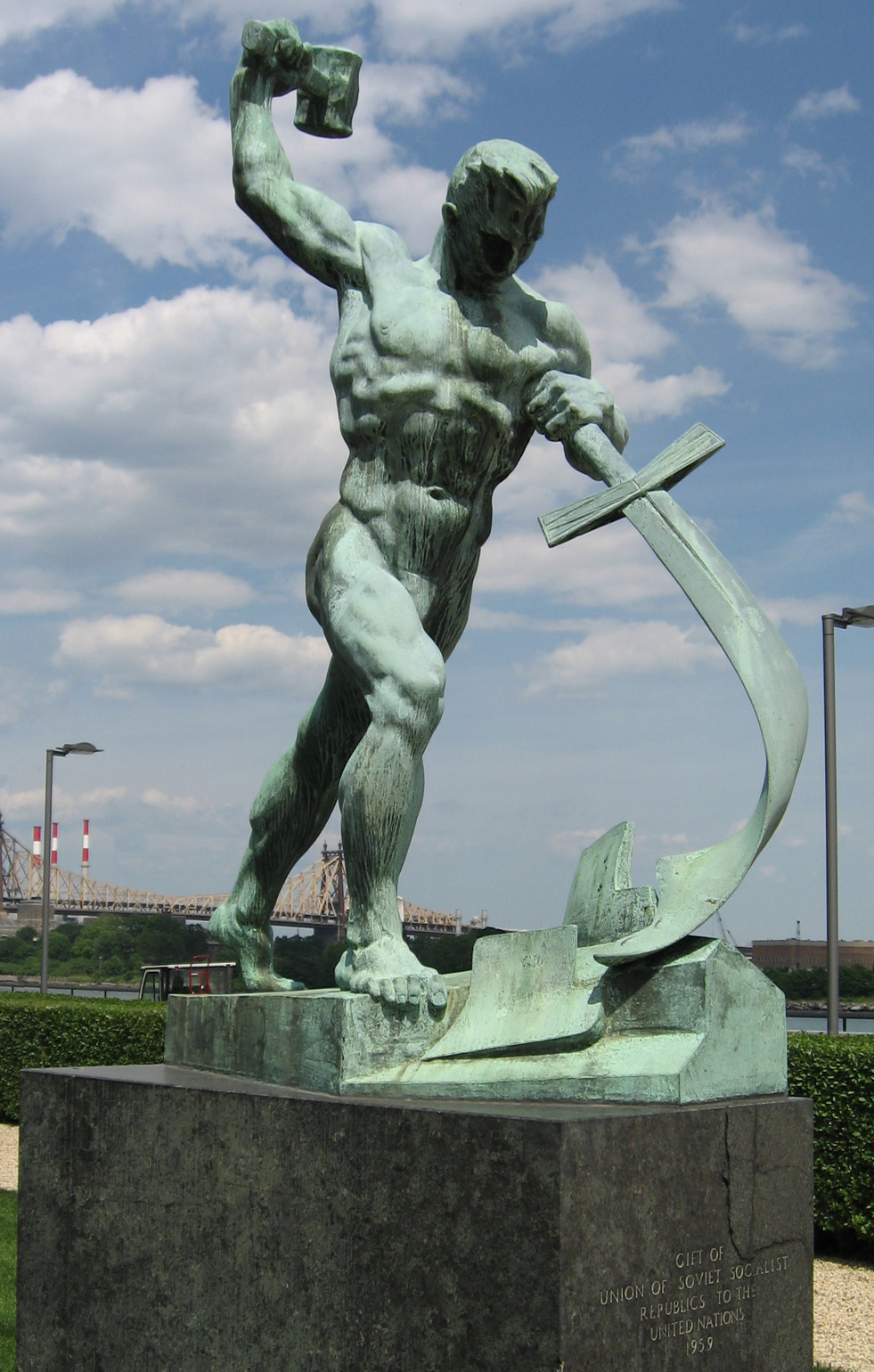
Outside the UN headquarters in New York, a new monument was unveiled: “Let Us Beat Swords Into Ploughshares.” The sculpture of a man transforming a sword into a plow became the symbol of a new era— weapons reforged for life, not for death.
For us, seeing it with our own eyes was a miracle. Our small village hall erupted in cheers and embraces. The Ukrainian girl beside me gripped my hand so tightly! In that moment we understood: miracles do happen—when you believe, as the child from Vissarion’s community had said.
Spiritual Awakening
After the first euphoric day, a long process of change began.
The leaders had given their word, but it would take time for the world to disarm and to learn to live without armies.
Gradually, over the following years, tanks were cut into scrap or transformed into tractors; warships were converted into hospital ships and research vessels; military bases were turned into schools and parks. At first there was suspicion—each country feared its neighbor might secretly be hiding weapons. That is why strict mechanisms of transparency were created: international inspections checked depots, satellites orbited overhead to ensure no secret preparations for war. The UN became more important than ever—not as a debating chamber over conflicts, but as an organizer of our collective effort to preserve peace. A permanent Peacekeeping Service was even established under the UN flag, a kind of world guard ready to intervene if the consensus was violated (though it was hardly ever needed, aside from minor incidents).
From the massive military budgets, an unprecedented resource was freed—the “peace dividend,” as economists called it. Imagine: in 2023, the world had spent about 2.44 trillion dollars on armies and weapons! Indirectly, violence and war had cost humanity far more—over 19 trillion dollars annually in destruction and lost opportunities. Now, all of this wealth was redirected toward good works. Hospitals, schools, and roads were built en masse. Scientists, instead of developing weapons of death, dedicated themselves to curing diseases and solving ecological problems.
Life improved tangibly: people everywhere began to live better; in Bulgaria and around the world, new jobs opened in peaceful industries. Former soldiers joined engineering brigades for infrastructure or special units for disaster relief, firefighting, and humanitarian aid.
But the most striking changes were social and spiritual. In the first years after the renunciation of war, a visible cultural transformation began. For centuries, nations had glorified military exploits—in songs, in films, in monuments to war heroes. Now war itself began to be seen as something shameful, belonging to a dark and bygone era.
Mothers no longer feared their sons would be taken to the front. I remember seeing on the news an elderly woman in Costa Rica quoting the saying: “Blessed is the mother who knows her child will never become a soldier.” Millions of parents around the world felt the same relief.
The image of the “soldier-hero” faded. My parents’ generation had grown up with war films; now, suddenly, new movies were being made about the heroes of peace—engineers, doctors, volunteers, and diplomats saving lives and preventing conflicts.
In schools, history books ended with a new chapter: “The Era of Wars” had concluded in 2025, followed by “The Era of Global Peace.” In literature classes we read anti-war poems; in ethics we learned tolerance and compassion. My own school even introduced a new subject: “Peace and Dialogue,” where we practiced resolving disputes with words, calming anger through meditation, and understanding different cultures.
Religious communities also embraced peace as a blessing. Priests, imams, and rabbis prayed together for the world. For many, the peace treaty was the fulfillment of ancient prophecies—a long-awaited Golden Age of brotherhood among nations. In our church, the priest compared the peace treaty to Isaiah’s prophecy of swords beaten into ploughshares. Others recalled that it had been the dream of Lyudmila Zhivkova—to build a new world on spirituality, beauty, and lofty ideals in children. Though her vision had been cut short, now it was finding its time. And an old man in our village, a student of Peter Deunov, insisted this was the coming of the Sixth Race foretold by the Teacher.
Everyone interpreted it according to their own faith, but all felt one thing: a moral uplift, a step forward in our human development.
The New World
After twenty or thirty years of peace, humanity began to reap the fruits of its new path.
By the 2050s, technologies once considered dreams had become reality. Freed from the arms race, the greatest scientific minds collaborated across borders. Technologies once reserved for military secrecy were released to the public: free energy from the quantum field (zero-point energy), anti-gravity propulsion.
This meant a practically inexhaustible source of clean, free energy, accessible to everyone. There was no longer any need to cover the Earth with solar panels and wind turbines; fossil fuels were left in the past. Power lines, transformers, and high-voltage towers became obsolete. Even asphalt highways ceased to choke the planet, as vehicles now flew, lifted by invisible fields.
The energy revolution brought the unimaginable: electricity became free and available to all. Together with the global peace dividend, this convinced governments to introduce a Guaranteed Basic Income for every human being in need. No one feared hunger or the struggle for mere survival. Machines and artificial intelligence took over much of the heavy labor, freeing people to unfold their potential.
Many dedicated themselves to art, science, education, or spiritual pursuits without the compulsion of wage slavery. A cultural and spiritual flourishing began— a new Renaissance. Inventions and creativity blossomed in every sphere of life.
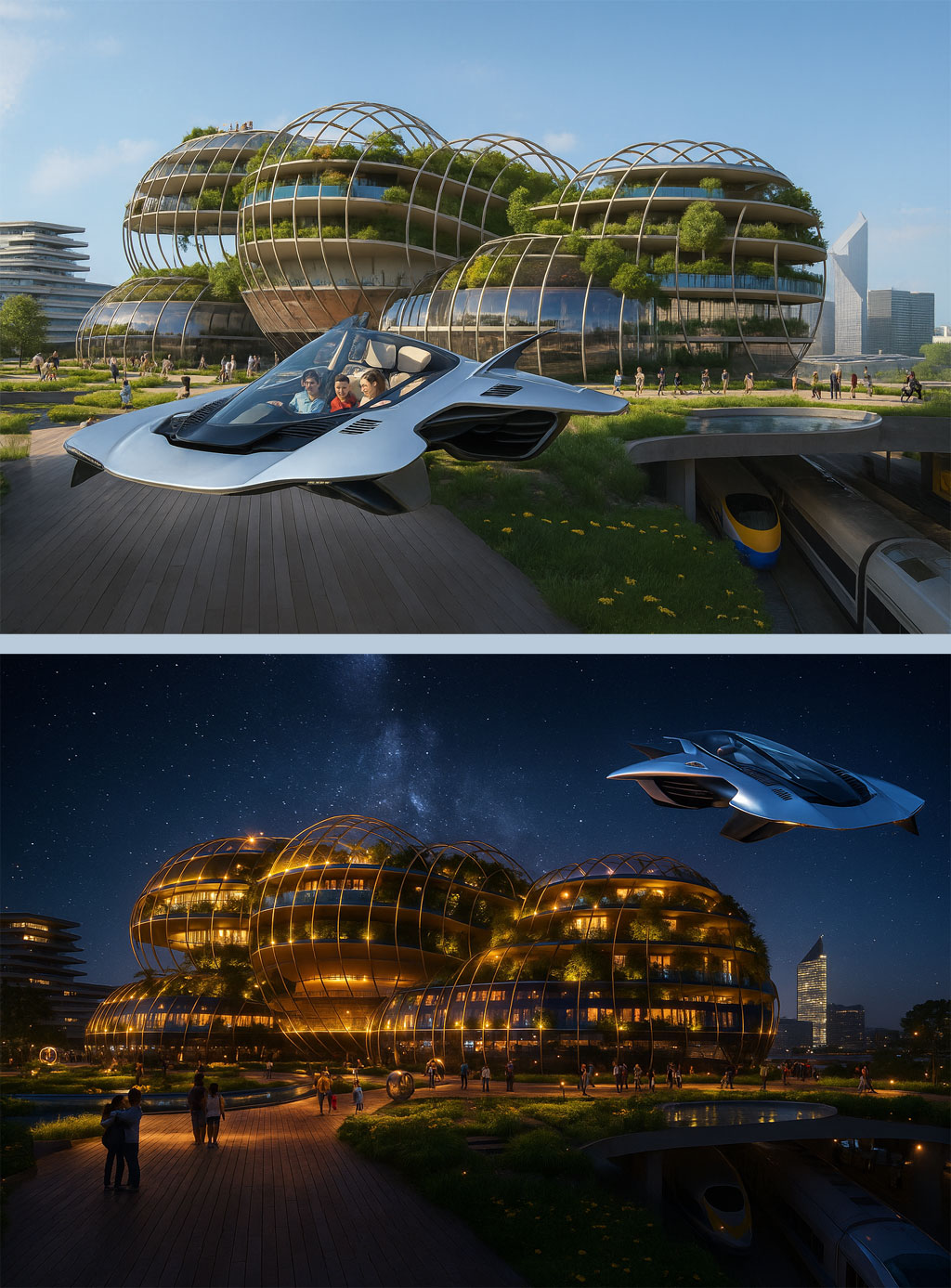 Cities were transformed. Instead of grey, polluted megacities, new eco-cities arose—green, filled with light, harmonized with nature. Architecture embraced human and spiritual dimensions: houses with gardens, flowing forms, water and light woven into design. Instead of endless highways clogged with smoking cars, people traveled in quiet, swift electric or magnetic vehicles. Whole districts became pedestrian zones with parks, fountains, and spaces for music and community life. Technology now served beauty, not profit.
Education underwent a revolution. No longer based on rote memorization and competition for grades, schools became centers of creativity and self-discovery. Children learned through projects, art, and service to their communities. Subjects like Ecology, Culture of Peace, and Inner Harmony became as fundamental as mathematics. Teachers were no longer authoritarian figures, but mentors helping children awaken their gifts.
Science, liberated from military contracts, flourished in astonishing ways. Diseases once deemed incurable—cancer, AIDS, even Alzheimer’s—were overcome. Vertical farms fed billions without destroying forests and fields. Humanity ventured into space with peaceful expeditions to the Moon and Mars—not to conquer, but to explore and learn together.
Economy was transformed. Old capitalism, built on endless consumption and profit, lost its meaning. People realized happiness comes not from having more, but from being more. Communities embraced new models of shared ownership, cooperative enterprises, and fair exchange. Nations measured success not by GDP, but by quality of life, human happiness, and ecological balance. Money no longer ruled humanity—humanity ruled money.
Life decentralized. With advanced energy and transport, millions left overcrowded cities to settle in villages, small towns, or eco-communities. Agriculture thrived with new technologies, making fresh food abundant even in remote places. The old divide between “city” and “countryside” dissolved.
In my own family, we returned to the Rhodopes to join a small, self-sufficient community among the green hills. Bright, ergonomic homes replaced dark, damp houses; gardens overflowed with fruit and vegetables. Children ran barefoot among flowers, playing freely with animals. In this new world, simple joys regained value—earth, sun, fresh air, and the laughter of children.
The contrast with a century earlier was staggering—back then, people crowded in concrete cities, living in alienation and fear. Now, in the 2060s, society had become peaceful and united. We gathered often under the stars—Bulgarians, Ukrainians, Russians, Turks, families of all origins who had settled in our valley—singing and telling stories together.
By 2065, humanity had truly matured. Forty years without war had shaped a new generation that knew conflict only from history books. Violence culture was replaced with a culture of peace and cooperation. We had developed a new civilizational ethic: every nation contributed its uniqueness to the whole, but aggression no longer had a place.
The value of life became inviolable—we understood that every human soul is priceless and irreplaceable. Old ideologies that sacrificed individuals for collective ambitions were abandoned. No sane leader would ever again send children to the battlefield for the vanity of warlords. Humanity had deeply embraced the conviction “never again war”—not as a slogan, but as a moral law.
Meeting the Brothers from Space
And then the (un)expected happened — they came.
On September 21st, 2065, the International Day of Peace (how symbolic!), humanity made its First Contact with extraterrestrial intelligence.
I remember it as clearly as if it were yesterday. Evening had fallen, and our whole village had gathered on the meadow above the houses to watch the fireworks for Peace Day. Children were playing, their laughter echoing in the crisp Rhodope air. The sun had just set behind the hills, painting the clouds gold.
Suddenly the world grew silent — the wind stilled, birds hushed, even the crickets stopped. Out of the sky descended a soft bluish-white beam. I looked up, and my heart leapt: above the Rhodope mountains hung a great silver disc, gliding soundlessly. It resembled no earthly craft I had ever seen. For a moment I thought I was hallucinating, but everyone saw it — pointing in awe, stunned into silence.
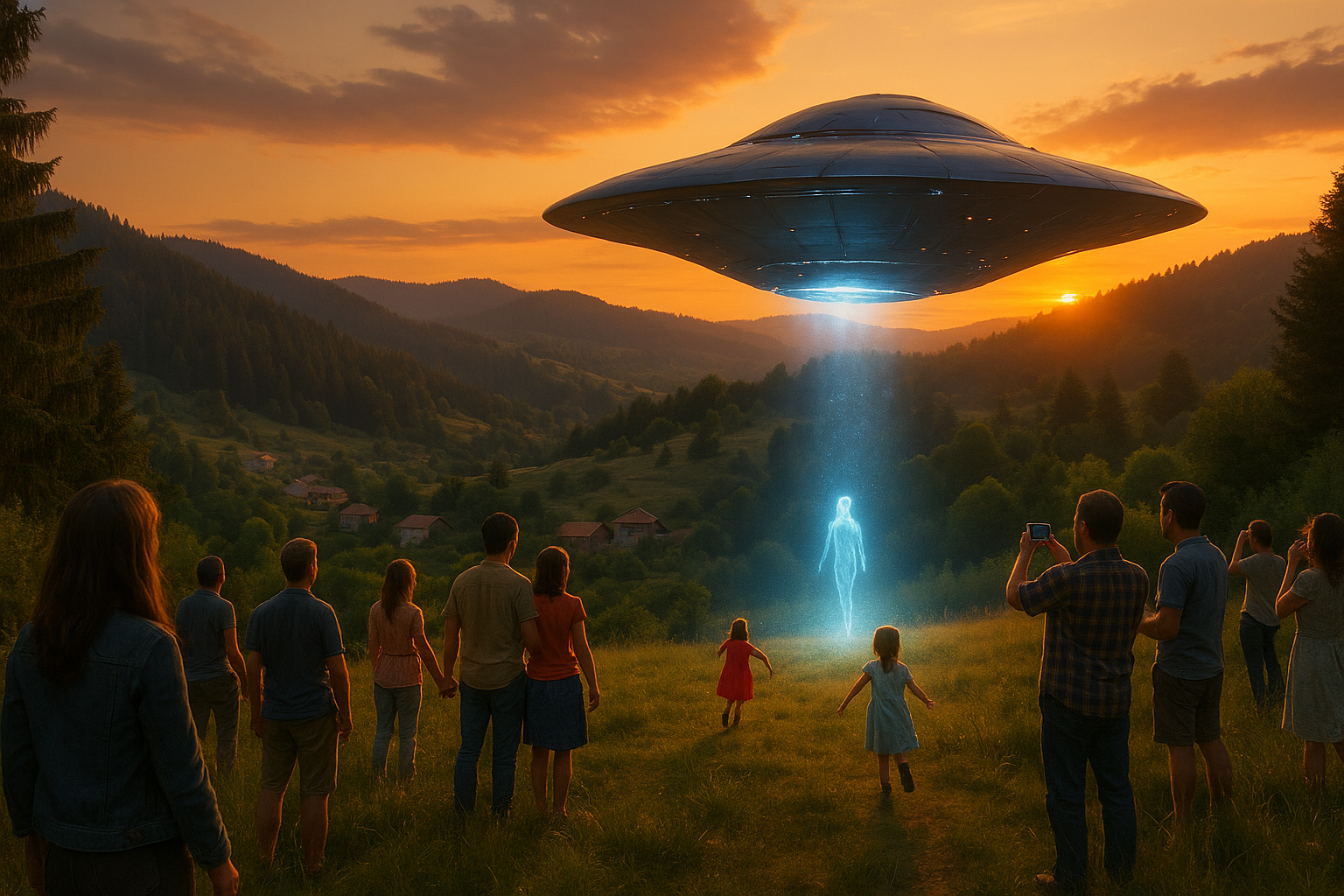 The craft moved slowly, radiating waves of gentle light. Soon, more appeared on the horizon. Later we learned that, at that same moment, peaceful ships revealed themselves above every settlement on Earth — so that all peoples might witness together.
We stood spellbound. There was no panic, no screams — only soft gasps of wonder. My little daughter pressed against me and whispered, “Mama, is that them?” I could only nod, smiling through tears. My eyes burned; such deep emotion flooded me that I could not stop weeping. For generations, humanity had dreamed of this day. And now, it was here.
From the craft, a holographic image appeared — the figure of a tall, graceful being with luminous eyes and a gentle smile. Though not human, its face radiated such kindness that no one felt fear.
The being spoke — in a voice translated instantly into every human language:
“We come in peace.
We have watched your world for a long time.
We witnessed your suffering and your struggles.
And we awaited this day — the day when you, the people of Earth, would reach harmlessness,
would become incapable of carrying cold and evil into the Universe.
Now you are ready.
We welcome you as our brothers and sisters into the great cosmic family.”
People around me wept with joy. My daughter whispered, “Mama, I feel they love us…” And indeed, that was what poured from their presence: love.
Two village children suddenly broke from the crowd, running forward with open arms toward the holographic figure. The being’s smile widened. It extended a hand as if to caress them. One little girl called out with a clear voice: “Welcome!”
At that instant I knew — this was the supreme triumph of humanity. Not generals, not governments, but the innocence of a child was welcoming our new friends from the stars.
Across the globe, the same scenes unfolded: peaceful ships above cities, messages of unity shared in every tongue. Crowds danced hand in hand in Paris, Delhi, Nairobi, Moscow. Never before had our planet been so united in joy.
In the days that followed, we learned much. These civilizations had observed us for centuries. They had seen our wars and our downfalls, wishing to help but waiting for us to mature — for spiritual lessons cannot be forced. Through prophets, teachings, and inspirations they had long whispered to us, but we had been deaf with ego and fear. Now, freed from hatred, we were ready.
They told us that humanity carries a unique gift — the warmth of the soul. While many beings possess intelligence and power, few carry such a radiant spark of divine love. Our task, they said, was to bring this warmth into the cold reaches of the cosmos, to enrich the galaxy with the fire of the human heart.
Now, a few years after the First Contact, life continues in its new rhythm. Representatives of Earth travel to other worlds as friends, while on our planet we welcome guests from distant constellations.
Just days ago, in our Rhodope village, we received a group of Urma — the tall, noble representatives of the intelligent race of cosmic felines.
It was late afternoon, the golden light of sunset playing across the stone slabs of the village square. The elders sat on benches, children ran among them, and in the center stood the Urma — towering compared to us, elegant in garments that seemed to weave together the future and tradition. Their faces radiated dignity, their eyes shone with that deep gaze which pierces beyond words.
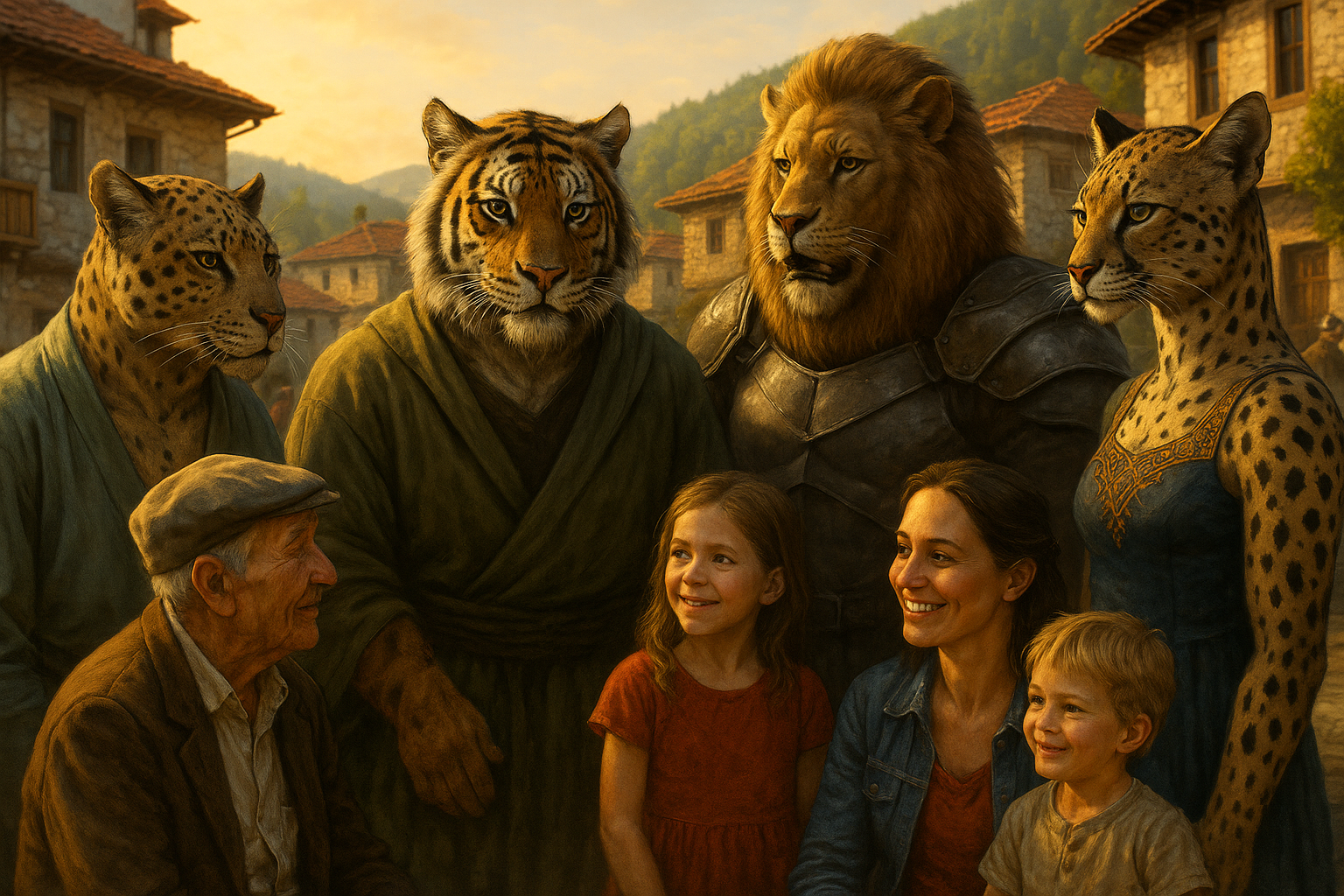 They did not speak with words. Instead, vivid, living images unfolded in our minds: crystal forests beneath purple skies, cities woven from light, heavens where three moons danced at night. We felt their emotions as well — calm, respect, curiosity, and a peculiar empathy toward us, as if we were long-lost kin.
One of them approached a small boy, knelt down, and touched his forehead with a paw. The child held his breath, eyes widening in awe. Later he said he had seen himself grown, planting life on a distant planet filled with singing birds and strange animals.
There is no need to hide our existence from one another anymore. Our children’s schools now teach not only Earth’s history but the history of the galaxy and the many races within it. We are learning of the wondrous paths along which our brothers of reason have developed — how different, and yet how similar, they are in their quest for knowledge, self-knowledge, and new horizons.
It turned out that Earth’s art and music enchant the extraterrestrials — they say nowhere have they heard melodies more beautiful than ours, especially the songs of the Rhodopes, born so often out of sorrow. Some even come especially to study with our spiritual teachers — imagine it, alien disciples learning from earthly masters! And yet, it does not surprise me: humanity endured a long road of trials, and in that was the meaning — to give birth to new Wisdom and Compassion, now treasured by the whole Universe.
Sometimes, at night, I step outside under the starry sky of the Rhodopes — the very same sky beneath which, as a child, I once wept over war and the world’s sorrow. Now I look up at the Milky Way and know that somewhere out there I have friends — countless friends — who know us and think of us. I feel no fear of the infinite, only joy and warmth.
I know that we, the people, have fulfilled the great purpose planted in our souls by our Father. We did not defeat enemies outside, but the darkness within ourselves. We turned our swords into ploughshares — not only in the literal sense, but in the spiritual. With the light of our souls, we scattered the shadows that had bound Earth for millennia. We warmed the Earth, and now our love will transform the Universe itself. From wild, warring tribes we became One Humanity — mature, peaceful, and wise, worthy to be called a child of Mother Earth and a member of the Galactic Brotherhood.
And it is hard to believe, but it all began with the faith of a handful of children who knew the miracle of love and belief. For truly: when you believe — everything becomes real.
The dream of Lyudmila Zhivkova had not faded. It had been reborn — in the faces of the children who now radiated light, in their hearts where compassion reigned. Perhaps her unfinished vision at Arkutino was only the seed, and the fruit ripened in this new era of peace. And who knows — perhaps she herself, from beyond, had stretched out a hand to help this world finally be born…
